The Art of Choreography

One of the most important parts of dance is what we create. It’s where we take an idea and shape it into something that can be seen, felt, and remembered.

Somewhere along the way, though, that artistry feels like it’s starting to slip.

We’re living in a time where extended class combos are being passed off as full routines, and in the process, the craft of choreography is getting lost.

I was at a competition recently, and by the end of the day, I felt like I’d watched a ping pong match — routine after routine bouncing from side to side, with no real direction, no shape, and no sense of purpose.

When I think back to icons like Bob Fosse and Twyla Tharp, their movement was so musical, so deliberate. It took up space. It breathed. It was alive. Choreography wasn’t just a series of steps — it was visual storytelling. These were artists who truly understood the relationship between movement and music.

Now, of course, I don’t expect an Under 8 jazz routine to showcase the choreographic genius of Chicago. But even at that level, there should be a developing sense of structure — clear floor patterns, shape, and intention. That structure doesn’t just serve the routine; it becomes part of the student’s dance education. These dancers might be the choreographers of tomorrow, and what we pass on to them matters.

Musicality is an also element that seems to be slipping away. It’s like choreography is happening next to the music, not inside it. Dancers pass through counts and miss the dynamics. The phrasing. The texture. And while I don’t think it’s entirely their fault, I do think we’re in a time where music appreciation just isn’t what it once was. So much of today’s music is overproduced and repetitive — it lacks the layers that give dancers something to respond to.

When I was growing up, I didn’t even realise I was getting a daily lesson in musicality. On the drive to dance each day, my dad would play classical music in the car and whistle along. I thought nothing of it at the time, but looking back, I know that’s where my musicality really started to develop — just by listening.

As dance educators and choreographers, we have a responsibility to pass these things down — to teach not just steps, but the art behind them. The students in front of us today will be the ones shaping the future of dance. What we give them — or fail to give them — matters.

Let’s not lose the craft of choreography in the chase for a trophy. Let’s bring back the intention, the structure, the story — and teach our dancers what true artistry is.

You might have the next great choreographer in your class. Make sure you’re giving them the tools they need to create their art.

Tricks impress. Choreography connects.

What’s the Best Dance School in [Insert Suburb]?

If you’re part of any local community Facebook group, you’ve probably seen the posts.

“Looking for a dance school for my [insert age] child. Any recommendations?”

Without fail, the comments roll in—people tagging studios they’ve been to, or ones they’ve simply heard of. It’s well-meaning, but not always helpful.

The truth is, there’s no one-size-fits-all when it comes to dance schools. What’s perfect for one child might be completely wrong for another. And that’s okay. What matters is finding the place that aligns with your values and where your child will genuinely thrive.

I often see studios recommended that are half an hour away, while great local options go unmentioned. In the age of Google and Instagram, there’s really no excuse not to do a little research yourself.

Start by narrowing your search to studios within a distance you’re happy to travel. Then take a look at their website and social media. Do they offer the styles you’re looking for? Does their approach feel aligned with your values? Years ago, you had a postage stamp-sized ad in the Yellow Pages. Now, you can get a real sense of a studio before you even step through the door.

And when one feels like it could be the right fit, book a trial. Step into the space. See how your child responds to the environment.

It’s also worth thinking about what your child actually wants. If they dream of a future in dance, you’ll want a studio with qualified teachers, performance opportunities, exams, and clear pathways to further training.

But if they just want to move, make friends, and have fun, then a recreational studio might be exactly what they need. There’s no right or wrong answer—only what’s right for your child.

Online recommendations can be a helpful starting point, but they shouldn’t be your only step. You’re not just picking an after-school activity—you’re choosing a space that will shape your child’s confidence, friendships, and maybe even their future.

I know my studio isn’t the right fit for every family. But for the dancers who do walk through our doors and feel at home—it’s exactly where they’re meant to be. And that’s what finding the right studio is really all about.

It’s not about picking the most popular name or the flashiest photos. It’s about choosing a place that truly sees your child, and helps them grow—not just as a dancer, but as a person.

Because your child’s dance journey is just that—theirs. And trusting a random comment on Facebook isn’t the way to choose a space that could shape their confidence and passion for years to come. It’s worth doing the research to find a studio that genuinely aligns with your child and your family.

Collaboration Over Competition

The idea of creating a collaborative group for studio owners and dance teachers has been sitting in the back of my mind for nearly a decade. I’ve always felt there was something missing in our local dance community, but I wasn’t quite sure what it was. I hadn’t pursued the idea until earlier this year, when I mentioned it to a friend and she simply said, “Do it.”

I’ve seen dance communities in other areas where mutual respect and a genuine sense of connection are the norm, but for whatever reason, that kind of culture feels harder to come by on the Gold Coast. That’s not to say it isn’t possible, but I knew if I wanted to see that kind of environment here, maybe I needed to help create it.

The Gold Coast Dance Alliance was born from a quiet but persistent thought: imagine what we could do if we all connected.

For too long, we’ve been living in the same world separately. And while no one is being required to join, I’ve created this Alliance as an open invitation. A space where dance professionals can see each other as people again. Where we can put a face to a name, and in doing so, move through this industry with more kindness, more integrity, and more thought.

The events we have planned reflect that intention. Some will be educational, others focused on wellness, some purely social and a few haven’t even been dreamt up yet.

I’m at a point in my life and career where I feel comfortable in who I am and what I’ve built. I’m not threatened, I know what I have to offer and I’m more than happy to share the lessons I’ve learned along the way.

Over the years, I’ve had countless conversations with other teachers who are quietly struggling with the same challenges I’ve faced. It’s shown me that so many of us are going through the same things—so what if we didn’t have to go through it alone?

Too often, we suffer in silence, thinking we’re the only ones feeling the pressure. But what if we didn’t have to? What if support, understanding, and collaboration were just a conversation or an event away?

I’ve spent years searching for this kind of community. And while I’ve been fortunate to build my own small Alliance, I know that’s not the case for everyone. For those who feel like they’re navigating this industry on their own—I want you to know, you’re not.

I’ve been touched by the number of people who have already reached out. There’s a real sense of excitement around the idea of connection, and it’s clear this is something our community has been craving for a long time.

We’re only at the beginning, but already it feels like the start of something meaningful.

Because when we choose collaboration over competition, we begin to build a stronger, more connected dance industry.

Let’s Talk About Ethics

I’ve been in this industry for over 20 years, and just when I think I’ve seen it all, something happens that reminds me the bar for ethics in the dance world can drop lower than a limbo stick.

The dance world has always had its messy moments. Studios splitting, students being poached, allegiances shifting. But lately, it feels like we’ve thrown out even the most basic professional courtesies. It’s the Wild West out there, people doing whatever they want, whenever they want, without much thought about the ripple effect.

And now, with Instagram and direct messaging just a tap away, the lines are even more blurred. You can reach anyone, anywhere and too often, people do. But just because you can doesn’t mean you should.

I have been part of the Gold Coast dance scene my entire life, and I’ve watched the culture shift. For the most part, there used to be a strong sense of ethics between teachers—an understanding of boundaries and mutual respect.

Of course, there were always a few who crossed those lines but to be honest, they were usually the ones at the top of their game. They had the experience and the ability to genuinely take a student to the next level. Right or wrong, it at least came from a place of proven value.

Now, it feels like those same lines are being crossed by people who haven’t earned that standing. The respect between studios is fading. There’s less regard for the relationships others have built with their students, and more focus on what can be gained quickly.

In today’s industry, it’s common for teachers to work across multiple studios. But that flexibility comes with responsibility.

If you’re teaching at multiple studios, you need to respect each one equally. That means leaving any bias at the door. You don’t compare studios. You don’t talk one up while standing in another. And when you leave a studio, you leave respectfully. You don’t contact students behind the scenes. You don’t encourage them to follow you. You don’t offer private lessons or classes outside of the space that paid your wage.

When you walk into someone else’s space, you are part of their team in that moment. And with that comes a duty of professionalism, neutrality, and respect for the relationships that exist within that studio.

And it’s not just teachers—dancers need to understand ethics too.

You can’t move through this industry thinking only of yourself. The choices you make and the way you treat people will follow you. This is a small industry, and your reputation matters more than you realise.

I’ve been part of this community for a

long time, and I’ll likely be here for many years to come. I’ve seen people come and go—often those who believed the rules didn’t apply to them. But the truth is, you don’t have a career until you’ve actually built one.

Real success is earned and it lasts when it’s built with integrity.

We may not have an official code of conduct, but there is a code. Or at least, there should be. And when we ignore it, we chip away at the culture of trust and mutual respect this industry desperately needs. It’s no wonder so many teachers avoid each other at comps and events. The unspoken tension is everywhere, and it’s exhausting.

So maybe it’s time to bring ethics back.

Our industry is only as strong as the ethics we uphold. If we want respect, we have to start by showing it. Dance better. Teach better. Be better. That’s how we move the industry forward.

Let’s create an industry we’d be proud to pass on.

Dancing in the Age of Instant Gratification

Lately I’ve been noticing how much harder it seems for young dancers to practise outside the studio. Past generations of dancers weren’t perfect but there was a consistency to practice that feels less common now.

Psychologist Jonathan Haidt talks about the rise of the “phone-based childhood”. Kids now grow up with screens in their hands and it’s changing the way they learn, how they interact with the world, and even how they show up in places like the dance studio.

We’re living in a world of instant everything—quick taps, fast swipes, instant likes. Our kids are getting constant hits of dopamine all day long just by picking up their devices. Their brains are being trained to expect instant feedback and when it doesn’t come quickly, the motivation doesn’t seem to be there.

Progress moves slowly. It’s built on repetition, mistakes, getting it wrong and trying again. There are no shortcuts—just slow, steady work. And somewhere in that process, there’s joy too. The quiet satisfaction of a routine improving, or exam work becoming more polished. It’s an experience many young dancers are missing out on and that’s a real loss.

And then there’s real life. Parents are busier than ever. Between work, school runs, and the constant juggle of family life, it’s easy for practice to slip off the radar. But here’s the honest truth: if you don’t see or hear your child practising… they probably aren’t. And with the cost of dance being what it is these days—costumes, classes, comps—it seems wild that the one thing that doesn’t cost a cent is the part that gets overlooked the most.

In a world where their brains are being rewired for speed and instant rewards, learning to slow down and stay with something hard is more valuable than ever.

With an endless stream of videos just a tap away, I sometimes wonder if it’s all become too much. Kids can spend hours watching dance content without ever leaving the couch. It creates the illusion of participation—like they’ve danced too.

Practice is where so much of the magic happens. It’s where dancers get to work on themselves—to focus, to explore, to repeat something until it feels better on their own body. There’s something incredibly satisfying about that kind of effort. It doesn’t take hours. Just ten mindful minutes, a few times a week, can shift everything.

The good news is, in a world built for instant gratification, we can make practice feel more rewarding. Something as simple as setting a weekly rehearsal time gives structure and purpose. Learning to find joy in repetition is a skill that will serve them far beyond the studio.

Practice doesn’t give you fireworks straight away. But over time, it builds patience, grit, confidence, and a quiet pride that no quick dopamine hit could ever replace. And that’s the kind of reward that truly transforms a dancer.

Maybe part of our job as teachers, parents, and mentors is to help them fall in love with the long game. In a world where apps are vying for their attention, it’s on us to remind them: some things take time and the most meaningful progress doesn’t come with a quick dopamine hit.

Thank You, Next

The dance industry is unlike any other. It’s a place where emotional investment is a key requirement of the job. As teachers, we pour our time, energy, and care into our students. This level of commitment creates deep bonds but it also means that when a student decides to leave, the impact can be profound. We cheer for them, support them through setbacks and milestones, and prioritise them over our own needs or even our own families. But one day, without warning, that student may choose to leave.

And while every dancer absolutely has the right to seek new opportunities, it’s important to remember that growth doesn’t happen in isolation. No teacher or studio owns a student, but a student does carry a responsibility to honour the journey that brought them to where they are.

Progress in dance doesn’t happen overnight. What a student achieves in a new environment is often built on years of foundational training. A dancer can often ride the momentum of that previous investment for years. So when we see posts crediting a new studio for an instant transformation, it can feel dismissive of all the work that came before.

Not every student is meant to stay forever. But how they leave a space that shaped them speaks volumes. Behind every polished performance is a teacher who gave more than what’s written in the job description. Teachers who stayed up late cutting music. Who gave up weekends to sit in theatres for you. Who believed in you, even when you didn’t believe in yourself.

And no, that’s not included in your term fees.

And for studios welcoming new dancers, it’s worth remembering that there should be an ethical window of time before promoting a student as your own. Yes, you’re proud to have them join your community. But publicly claiming a dancer as your own within days or weeks of their departure from somewhere else can be deeply hurtful to the teachers who poured years into that journey. Being instantly replaced isn’t just hard, it’s heartbreaking. A little pause. A little grace. It goes a long way.

Welcoming a new student is a privilege, not a prize. Taking the time to honour where they’ve come from doesn’t diminish your studio, it reflects your integrity. Respect for the past creates space for a stronger dance community, because at the end of the day, we’re all in this together.

Leaving a studio doesn’t mean burning a bridge. It’s a chance to show gratitude. In an industry as small and interconnected as dance, how you leave says just as much as how you showed up.

Open and honest communication is always better than silence. Leaving suddenly, without conversation or explanation, can feel like a blindside and often leaves teachers confused, hurt, and questioning what went wrong.

Be kind. Be respectful. Remember the people who helped build you. It’s not just about being a good dancer. It’s about being a good person.

How you leave says a lot about the dancer you are becoming.

Dance is a Marathon, Not a Sprint

Each year, the standard of dance continues to rise. With social media showcasing child prodigies, it can feel like the pressure to reach an elite level is happening earlier than ever. But the reality is, exceptionally talented young dancers have always existed—the difference now is how visible they are.

In the rush to cultivate talent, many dancers are pushed too hard, too soon. But true success in dance isn’t about being the most accomplished 8-year-old—it’s about becoming the strongest, most capable 18-year-old as they embark on their careers. Some dancers naturally figure things out faster, whether it’s picking up choreography, refining technique, or understanding performance quality. But in the long run, the others catch up. A dance career is a long game, and those who thrive are often the ones who develop steadily, pace themselves, and sustain their passion rather than burning out.

I know this firsthand. I left school at 14 to focus entirely on dance. At the time, it seemed like the right choice for a future in classical ballet. I trained relentlessly, won countless trophies, and by 18, I had achieved what many would consider dance student success. But by then, I was burnt out. The trophies didn’t matter. What mattered was longevity, and I had pushed so hard that I had nothing left to give when it truly counted.

Fortunately, I was lucky to come across teachers who encouraged me to keep going even when I felt like I had nothing left. Their support and belief in my potential helped me push through when I might have otherwise walked away. Having the right mentors who see the bigger picture can make all the difference in a dancer’s journey.

A perfect example of the slow and steady approach is Misty Copeland. She didn’t start dancing until she was 13, yet she went on to become the principal dancer of the American Ballet Theatre. If you can reach the pinnacle of the ballet world starting at 13, then going all in at age 10 is not a requirement for success. The path to a professional career doesn’t have to be rushed—it needs to be nurtured.

Within my own studio and learning from my own experience, I embrace a slow and steady ethos. I firmly believe that students who show potential can absolutely reach a professional standard, even if there are others who may appear more naturally talented at a young age. Progression and longevity in dance aren’t about being the best early on; they’re about continuing to grow, refine, and develop at the right pace.

Dancers need time to develop—not just physically, but mentally and emotionally. The body needs time to build strength and resilience to avoid injuries that often come from overtraining too young. The mind needs time to mature, to learn how to navigate the inevitable highs and lows of a dance career. The dancers who sustain long-term success aren’t always the ones who shone the brightest as children. More often, they’re the ones who were given the time to grow into their potential at the right pace.

Instead of racing to be the best as a child, the focus should be on steady, progressive growth. A strong foundation, a deep love for the art, and the patience to let true potential unfold—those are the qualities that create lifelong dancers. Because in the end, trophies don’t count. Longevity does.

For the love of dance

Being a dance teacher is one of those rare careers that often begins in early childhood. Many of us started dancing before we even started school, and that love for movement has shaped our entire lives. But what happens when that passion starts to fade?

As dance teachers, we are natural people pleasers. We bend, adjust, and push through to meet the needs of our students and their families. But in doing so, we sometimes forget ourselves. We lose sight of why we fell in love with dance in the first place.

Over time, the joy that once came naturally can start to feel like something we have to manage. And while teaching dance is a job—so much of what we give goes beyond what’s paid. The extra hours, the unseen effort, the emotional investment—it all comes from passion.

Last year, I was ready to walk away. The passion that once fueled me had dimmed, and I found myself going through the motions without any real joy. In a profession where our energy directly impacts our students, that wasn’t sustainable. So, I made a choice—to reconnect with what I love.

We spend all day dancing, yet rarely do we dance for ourselves.

This year, I decided to step back into the studio. Not as a teacher, but as a student. I’m incredibly fortunate to be able to take class with my best friend, who teaches the most wonderful open adult ballet classes. Adding this simple ritual to my weekly routine reawoke something in me—a part of myself I had forgotten. The pure, simple joy of dancing just for me.

Watching the women in these classes was a gentle reminder of something I’d lost sight of. Here were dancers of all backgrounds, simply enjoying movement. It was refreshing and reminded me—how lucky am I to have turned something I fell in love with as a child into my career? Teaching is incredibly difficult, but it isn’t just about serving my dance community. It has to be for me, too. That balance is what keeps the passion alive.

Sometimes, all it takes is a small shift to reignite that spark. Freshen up your dance wardrobe, buy a new pair of teaching shoes or invest in some professional development. Even the smallest changes can rekindle excitement and remind you why you fell in love with dance in the first place.

And here’s the biggest lesson: You don’t have to teach every class or please every student. If exhaustion creeps in and your once-beloved pre-primary ballet class makes you question your existence? The answer is simple—step away from what doesn’t bring you joy. There’s always someone else who thrives in that space, and your energy is better spent where you shine. A happy teacher is a good teacher.

If you’re feeling stuck, remember why you started. You dance because you love it. And don’t forget to make space for yourself in the art you have dedicated your life to.

Your love for dance is what brought you here—don’t let it be the thing you forget.

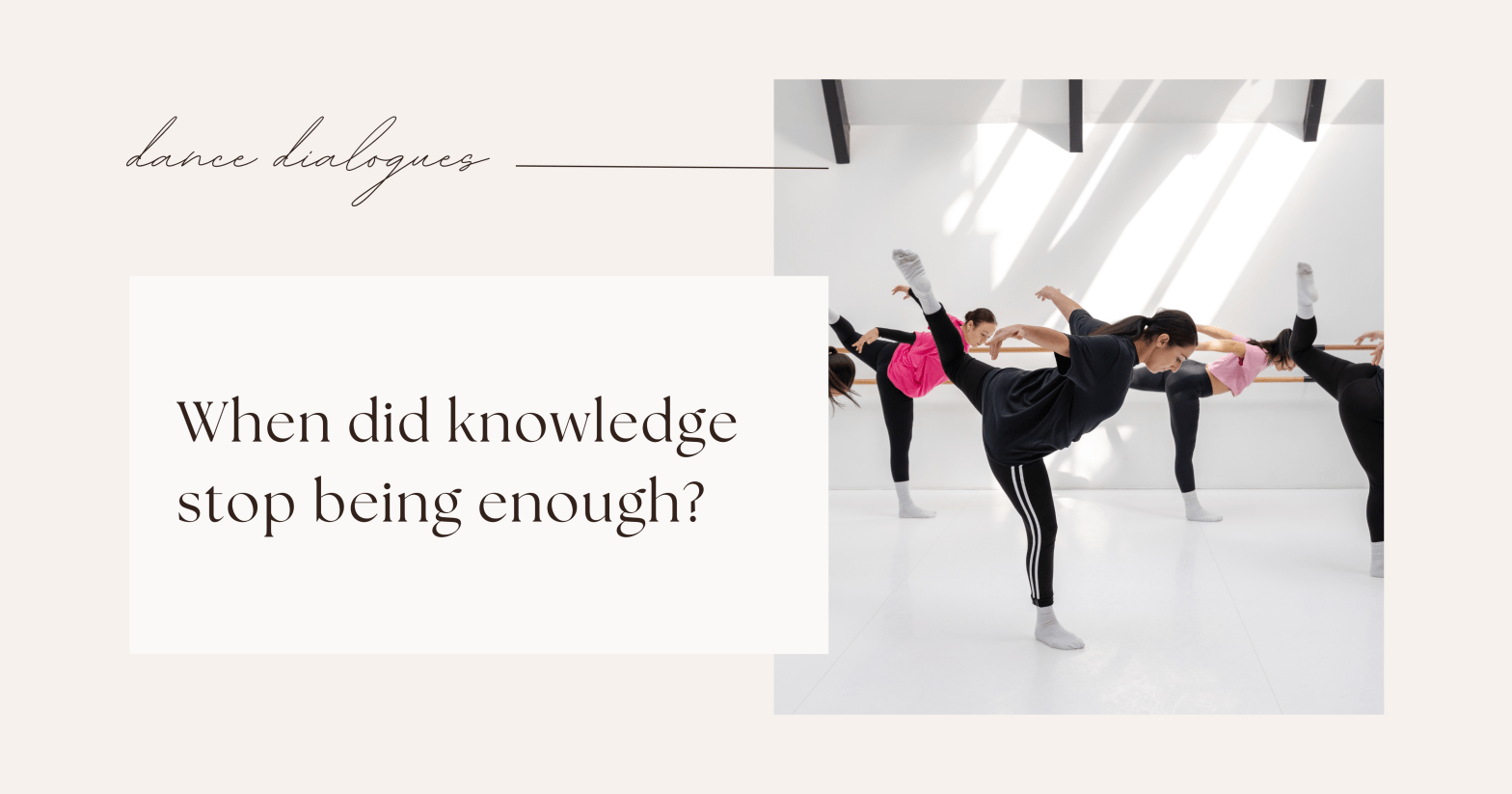
When did knowledge stop being enough?


We often say ‘knowledge is power,’ but lately, experience and true understanding seem overshadowed by catchy programs, social media trends, and quick fixes. I find myself having conversations with colleagues and mentors about the increasing struggle to get people to listen. Dancers and parents are drawn to what looks exciting rather than what actually builds skill and longevity.

The question is: when did knowledge stop being enough?

I’ve noticed something interesting in my own journey. When I was a young teacher, people seemed to listen more—perhaps because fresh energy and enthusiasm are enticing. But now, with more experience, proven results, and a deeper understanding of dance, it feels like people are more willing to overlook what I have to say. Ironically, I’m far more equipped now than I was then.

Yet, in an industry that increasingly values fast success over expertise, those with real knowledge often have to fight to be heard. It’s time we shift our focus back to what truly matters—real training, real experience, and real results over hype.

Lately, there’s been a shift where dancers and parents seem to place more value on programs and workshops than on regular, consistent training.

The idea that a “specialised program” will guarantee success is misleading. A viral “secrets to success” program will not make up for years of dedicated, structured training with experienced teachers.

You don’t need to land eight pirouettes to succeed in dance. You need strong foundations, an understanding of artistry, musicality, professionalism, and longevity. Dance isn’t about collecting flashy tricks—it’s about developing the technique, discipline, and mindset that will sustain you for years to come.

Stop ignoring the teachers who have put in the work. The ones who have lived it, learned from experience, and understand what it takes to build a successful dancer—not just for a moment but for a career.

If you truly want to succeed in this industry, listen to those who have been there before you. Learn from the ones who have seen generations of dancers rise and fall, who know what works and what doesn’t. Trends and catchy programs will come and go, but true knowledge—passed down from those who have dedicated their lives to this art.

Knowledge will always stand the test of time.

Nothing changes… if nothing changes.

Once again, the dance world finds itself entangled in controversy. And once again, our community comes out with strong opinions, discussions about the lack of regulation, and calls for the protection of young dancers. These concerns are valid, and our industry does need reform and regulation to ensure the safety and well-being of our dancers.

However, while we wait for these bureaucratic changes to materialise, the most impactful transformation starts with our own actions and behaviour. Scrolling through posts, it’s hard not to notice a glaring contradiction—many of the voices calling for safer environments for young dancers are not leading by example. It’s easy to demand change, but much harder to embody it.

In today’s world, young dancers are incredibly talented and often display maturity beyond their years, but that does not mean they should be subjected to adult themes under the guise of artistry.

There is a distinct difference between a seasoned commercial dancer performing a suggestive routine and a child mimicking the same moves. The lines between age-appropriate choreography and hyper-sexualization have become blurred, largely influenced by a music industry entrenched in a “sex sells” philosophy.

Yes, we need a regulatory body to oversee our industry and safeguard our dancers. But change doesn’t have to wait for bureaucracy to catch up. Change starts with us—today, in our studios, in our classes, in our choices.

If you’re in a position of influence—be it as a teacher, studio owner, choreographer, or industry leader—ask yourself, are your actions aligning with your words? Are you fostering a safe space for young dancers to explore their artistry without compromising their innocence?

We often say that one person can’t change the world, but the ripple effect of individual action can create waves of transformation. Be the change you want to see. Lead with integrity, teach with purpose, and protect the art form we love by making it a safer space for the next generation.

Because nothing changes, if nothing changes.

And the first step is ours to take.

Kate Grazioli

Educator | Studio Owner | Mentor

Skip to content ↓